California’s move to legalize plug-in balcony solar shows where the energy market is heading: more access, more self-consumption, and more control for homeowners.
Lawmakers in California have introduced new legislation that would allow residents to legally use plug-in solar systems on balconies and small residential spaces, significantly simplifying the process of connecting these systems to the household electricity network.
The proposal, known as Senate Bill 868 (SB 868), was introduced by State Senator Scott Wiener and is titled the “Plug Into the Sun Act.” The bill forms part of a broader legislative package aimed at expanding clean energy access while helping households cope with rising electricity costs.
Under the proposed law, small-scale, plug-in solar photovoltaic systems with a capacity ranging from 400 W to 1,200 W would be permitted to connect directly to standard 120-volt household outlets. These systems typically include integrated microinverters that convert direct current (DC) generated by solar panels into alternating current (AC) suitable for immediate household consumption.
If approved, the legislation would prevent utilities from requiring formal interconnection agreements or complex permitting processes for these devices. Instead, the systems would be treated similarly to common household appliances, removing a key regulatory barrier that has so far limited their adoption in California.
Supporters of the bill argue that balcony solar systems could help residents reduce household electricity consumption by up to 20%, translating into potential annual savings of approximately $450 per household. The technology is particularly attractive for renters, who make up around 44% of California households, as the systems are portable and can be relocated when tenants move.
California’s residential electricity rates have nearly doubled over the past decade and are expected to continue rising through 2026, increasing pressure on lawmakers to explore affordable energy solutions for consumers.
The proposal has gained backing from a range of environmental and industry organizations, including the Environmental Working Group, the California Solar and Storage Association, and the Solar Rights Alliance, all of which emphasize the role of plug-in solar systems in democratizing access to renewable energy.
At present, California regulations often classify small plug-in solar devices under the same framework as larger rooftop solar installations, subjecting them to costly and time-consuming approval procedures. SB 868 seeks to reclassify these systems as low-risk consumer energy devices, aligning state rules more closely with international practices.
Similar balcony solar systems are already widely used across Europe, particularly in Germany, where more than four million units have been installed. In the United States, Utah has already adopted legislation permitting the use of plug-in solar systems.
The California Energy Commission and the California Public Utilities Commission are expected to review the bill in the coming months, with legislative discussions anticipated later this year.
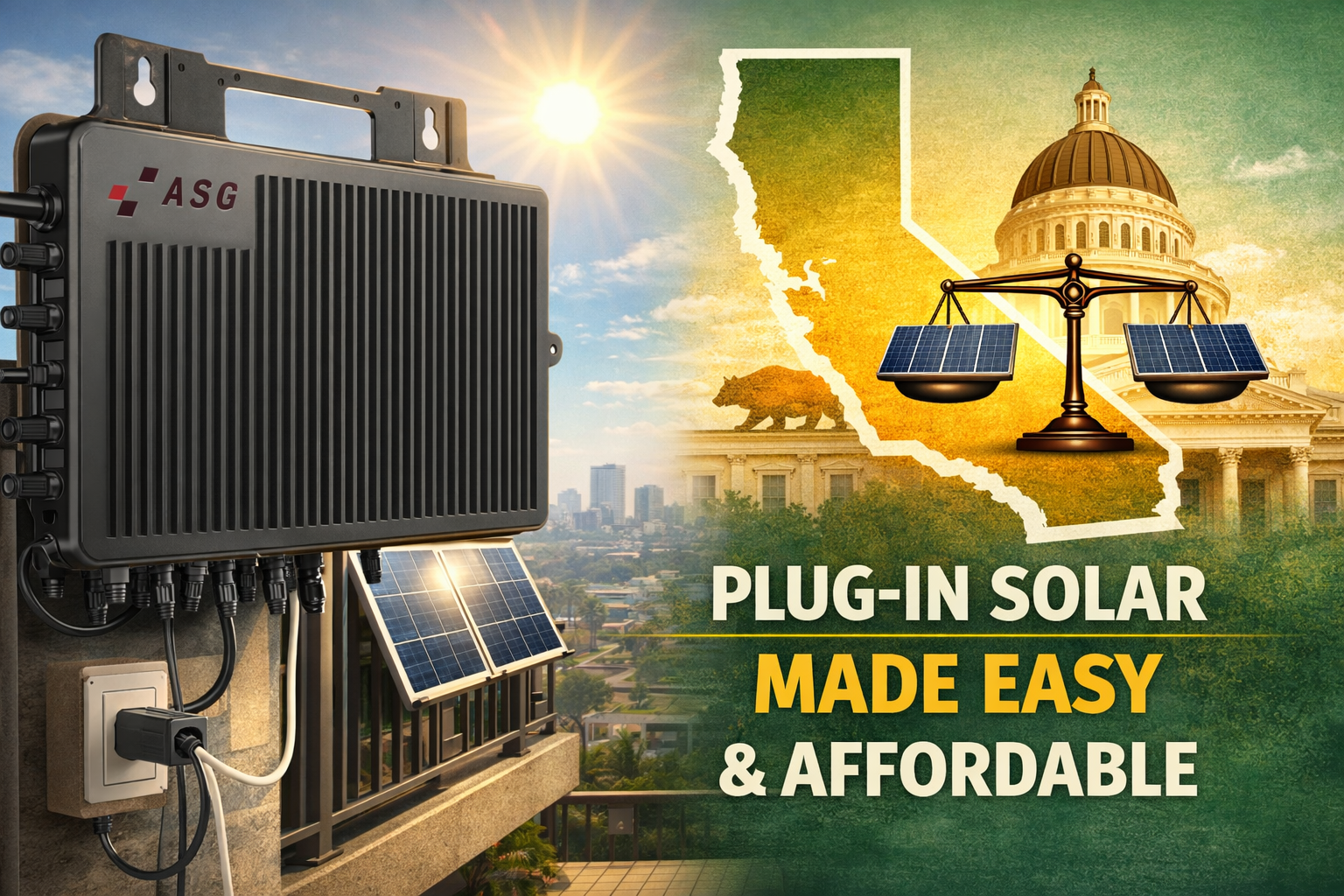
With the legalization of plug-in solar systems, reliable storage-ready microinverters are becoming essential for balcony and small-scale PV installations. ASG’s 1 kW and 2 kW energy storage microinverters offer an efficient, plug-and-play solution for residential users seeking greater energy independence.
Learn More: https://www.asg.energy/1-2kw-energy-storage-mircoinverter
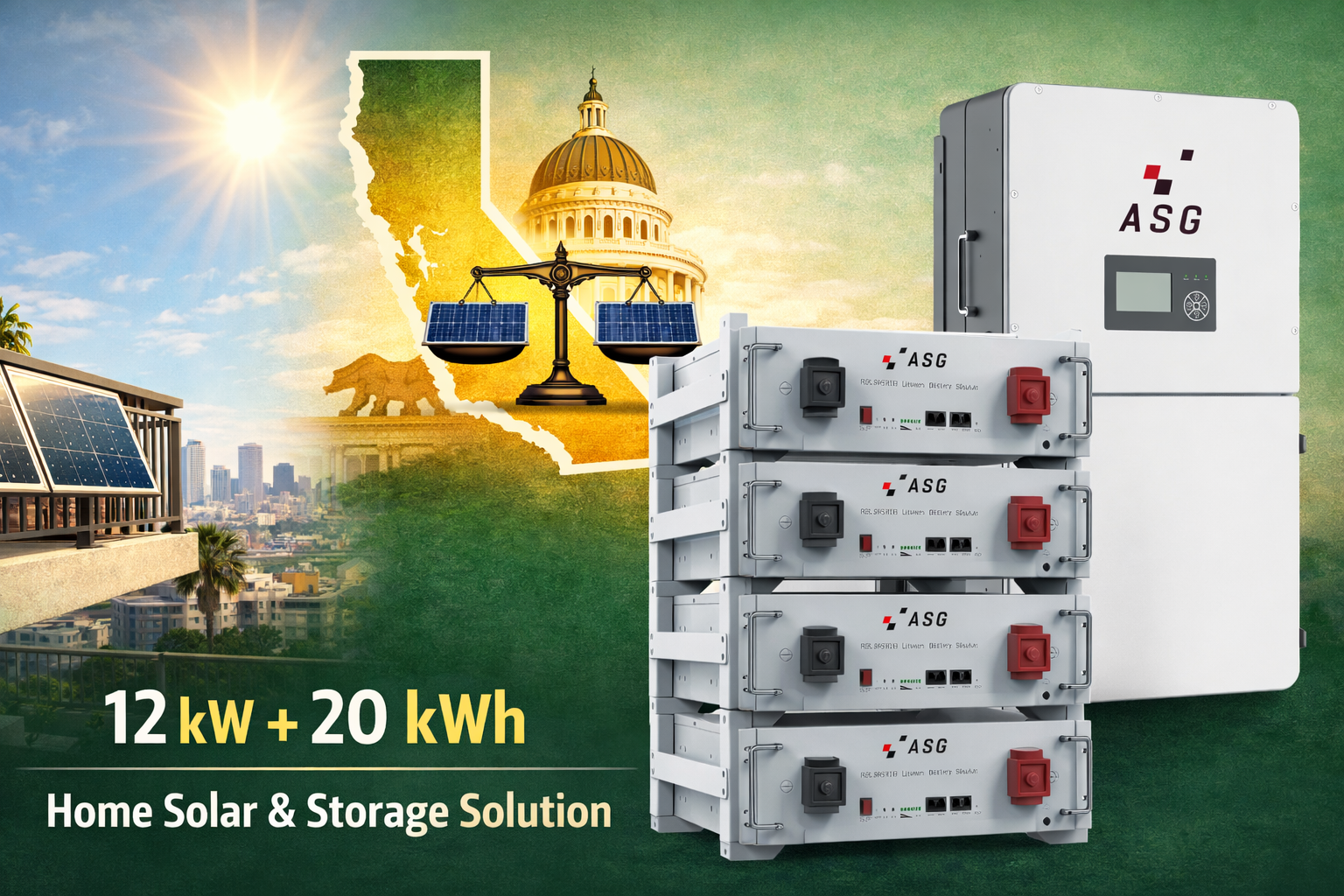
While plug-in balcony solar systems mark an important step toward energy accessibility, many homeowners are looking for more robust solutions to maximize savings and resilience. ASG‘s 12 kW solar system combined with a 20 kWh home battery delivers whole-home power, backup protection, and long-term control over energy costs.
Learn More: https://www.asg.energy/12kw-energy-storage-hybrid-inverter